Posts

Lectures from Colombo To Almora: #2 Jaffna, 24 Jan 1897

Swami Vivekananda proceeded to Jaffna from Colombo. He had to shelve his plan of sailing for Madras (Chennai) from Colombo as he was receiving numerous telegrams from various Tamil-inhabited towns of Sri Lanka to visit them. On January 19, he took the train to Kandy — the hill station inhabited by tea plantation workers from Tamil Nadu. He was welcomed at the Kandy railway station by a traditional band and temple insignia amid loud cheers.  After delivering a brief speech, Swami Vivekananda set out for a long, arduous journey to Jaffna by a stagecoach as there were no railway line linking Kandy and Jaffna in those days. It was during this 200-mile journey that an outrageous incident happened. After nearly 50 miles, the coach broke down near Dambulla, known for its famous cave temple complex. This forced him to take a bullock-cart to reach Anuradhapuram, the ancient capital of Sri Lanka and the largest ‘buried city’ of the world.  Anuradhapuram hosts the Bo-tree, offshoot of th...

Lecures From Colombo to Almora: #1 Colombo, 16 January 1897

One hundred and twenty five years ago, to the day, on the evening of the 16th January 1897, Swami Vivekananda gave a public lecture on "India, the Holy Land" in the Floral Hall, Colombo, Sri Lanka. Swami Vivekananda had arrived in Colombo by the German steamer 'Prince Regent Leopold' on 15 January 1897. He was met on board by the reception committee comprising Swami Niranjanananda, Kanakasabai, Sockanathan and T.G. Harrison, a Sinhalese Buddhist. A decorated steam launch took him to the pier where thousands had gathered to cheer him. From the harbour he rode in a carriage to Barnes Street in Cinnamon Gardens accompanied by Ponnambalam Coomaraswamy, Member of the Legislative Council, and a sibling of the better known duo, Ponnambalam Ramanathan and Ponnambalam Arunachalam. The whole street had been lined by festoons and topped by arches made of coconut leaves and palmyrah fronds.  This was his first public lecture in the Indian subcontinent after his return from the We...

An afternoon at the Chennakeshava Temple, Somanathapura

Image
The Hoysala Empire ruled most of what is now the state of Karnataka between the 10th and the 14th centuries. The capital of the Hoysalas was initially located at Belur but was later moved to Halebidu, both of which still have the remnants of the magnificent temples that were constructed. In the year 1258 CE, Somanatha Dandanayaka, a general of the Hoysala King Narasimha III built a temple to Sri Krishna at Somanathapura which in later centuries would come to epitomize the best of Hoysala architecture.  A little over fifty years after the temple was consecrated, it was attached by Islamic  invaders. The first attack was by Malik Kafur, Alauddin Khilji’s general in 1311 and in 1326 Muhammad Bin Tughlaq destroyed the remaining structures.  The invaders forced the king Veera Ballalla III to submit, and looted him of 312 elephants and 20,000 horses, besides jewellery. The king fled to Tiruvannamalai, but died in Madurai, while fighting the invaders. The account of Ibn Bat...

Book Review: Mahabharata Unravelled

The outlines of the Mahabharta and the life trajectories of the major characters are well known to every Indian, whether or not they have read the epic. We've been exposed to it since our childhoods and B.R.Chopra's fantastic TV series influenced the entire nation - cities and towns across the nations would virtually go into what we now call lockdown when the series aired on Sunday mornings on Doordarshan, the national  (and only!) broadcaster. Many of us read the many Amar Chitra Katha comic books  which embedded the visual characterization of many of the characters in our mind. We all know of the good cousins - the Pandavas, their ongoing struggle from birth with their 100 Kaurava cousins who were jealous of them. We feel sorrow for the accident of birth of Karna which led him to the side of the Kauravas, the might of Bhima, the archery of Arjuna, the self-respect of Draupadi, the Empress of India and the divine presence of Krishna, the incarnation of Lord Vishnu, throughout...

Preparing for Death

In a letter that he wrote in 1789, Ben Franklin, one of the leaders of the American Revolution, wrote: Our new Constitution is now established, and has an appearance that promises permanency; but in this world nothing can be said to be certain, except death and taxes. In spite of this, tax avoidance, tax deferral and tax evasion are common occurrences in today's world. However, there is no avoidance, deferral of evasion of death. Given this, how should we think about death and prepare? In his famous commencement speech at Stanford University in 2005, Steve Jobs, the founder of innovative companies Apple and Pixar said: When I was 17, I read a quote that went something like: “If you live each day as if it was your last, someday you’ll most certainly be right.” It made an impression on me, and since then, for the past 33 years, I have looked in the mirror every morning and asked myself: “If today were the last day of my life, would I want to do what I am about to do today?” And whene...

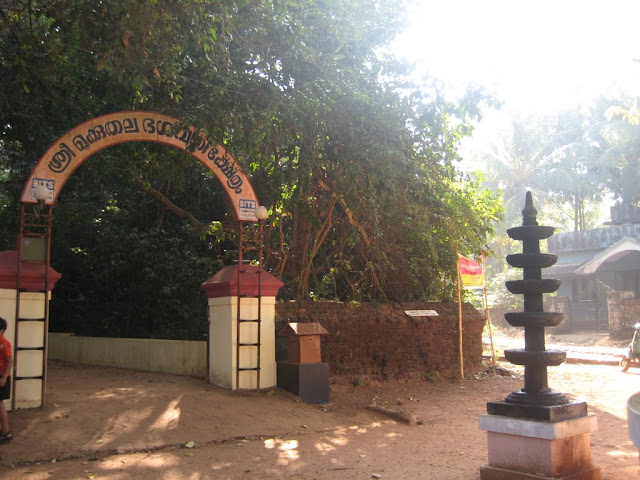
The Temples of Mookuthala, Kerala

Image
The village of Mookuthala, in Kerala's Malappuram district, is home to three powerful temples of the Divine Mother:  The Mookkuthala Bhagavathy Temple (also known as Melekkavu), the Durga Temple (also known as Keezhkavu), and the Kannenkavu Bhagavathy Temple, the abode of Goddess Bhadrakali. Most of the content below is from a brochure published by the temple in the 1980s: The legendary and famous Devi kshethra known as Sri Mookkuthala Bhagavathy Kshethra is situated in the panoramic village of Mookkuthala in Ponnani Taluk of Malappuram District in Kerala It is 28 km away from the famous Guruvayur Lord Krishna Temple and is 3 km to the west of Changaramkulam on the Guruvayur-Kozhikode highway. Kerala is known for its Sakthipooja and there used to be 108 illustrious Durga Temples in this land. The Mookkuthala Bhagavathy Temple is one of those ancient Durga temples. The Temple is 1200 years old (as it was consecrated by Jagadguru Sankaracharya) and the many legends connected with its...